Multivitamin Softgel Capsules

Best Nutraceutical Companies
October 3, 2026
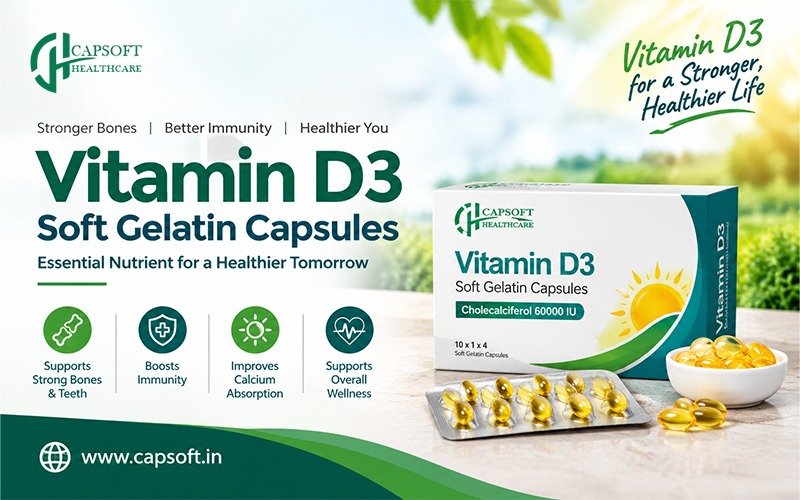
Vitamin D3 Soft Gelatin Capsules
October 8, 2026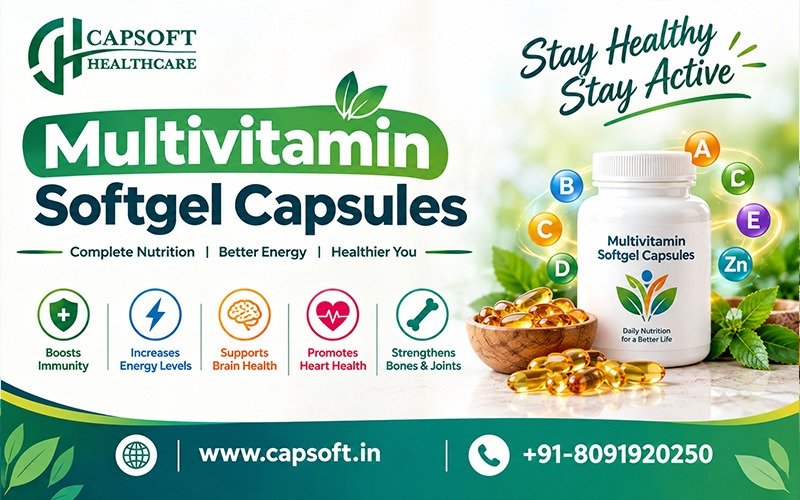
Multivitamin Softgel Capsules: Benefits, Uses, Manufacturing Process and Manufacturer Guide
Multivitamin softgel capsules are widely used to provide a convenient combination of essential vitamins and minerals in a single dosage form. They are popular in the nutraceutical industry because of their easy consumption, consistent formulation, and suitability for oil- and fat-soluble nutrients.
For brands planning to launch or expand their supplement range, selecting reliable multivitamin softgel capsules manufacturers is an important step. A capable manufacturer can support formulation, encapsulation, quality control, packaging, and regulatory requirements while helping brands develop products according to their target market.
Capsoft Healthcare – Multivitamin Softgel Manufacturing Solutions
Capsoft Healthcare is a softgel manufacturing company based in Baddi, Solan, Himachal Pradesh, India. The company focuses on the manufacturing of pharmaceutical and nutraceutical softgel products for businesses looking for contract manufacturing, third-party manufacturing, and private-label solutions.
Multivitamin softgels can contain a carefully selected combination of vitamins, minerals, antioxidants, and other nutritional ingredients depending on the intended product positioning. The formulation can be developed according to dosage requirements, ingredient compatibility, capsule size, and market needs.
Capsoft Healthcare supports businesses through different stages of softgel production, including formulation support, manufacturing, quality checks, packaging, labeling, and documentation.
For companies comparing Nutraceuticals manufacturers in India, manufacturing capabilities, quality systems, production experience, ingredient sourcing, and documentation support should all be considered before selecting a long-term manufacturing partner.
What Are Multivitamin Softgel Capsules?
Multivitamin softgel capsules are oral supplement products formulated with multiple vitamins and, in some cases, minerals or other nutritional ingredients. The active ingredients are enclosed within a soft, flexible shell.
Unlike conventional tablets, softgel capsules are manufactured using a specialized encapsulation process. Their smooth shell makes them relatively easy to swallow, while their formulation can be suitable for nutrients that are better incorporated into oil-based or liquid-filled systems.
A multivitamin formulation may include nutrients such as:
- Vitamin A
- Vitamin C
- Vitamin D
- Vitamin E
- Vitamin B1
- Vitamin B2
- Vitamin B6
- Vitamin B12
- Folic acid
- Niacin
- Biotin
- Pantothenic acid
- Selected minerals, depending on the formulation
The exact ingredients and quantities vary from product to product. Manufacturers generally formulate products according to the intended nutritional purpose, dosage requirements, stability considerations, and applicable regulations.
Why Are Multivitamin Softgel Capsules Popular?
The demand for multivitamin supplements has increased as consumers look for convenient ways to include essential nutrients in their daily routines. Softgel technology provides another advantage because it allows manufacturers to work with a variety of formulations.
Some important reasons for the popularity of multivitamin softgels include:
Convenient Dosage Form
A single capsule can contain several nutritional ingredients. This makes multivitamin products convenient for consumers who prefer not to take multiple individual supplements.
Easy-to-Swallow Format
The smooth and flexible outer shell of a softgel can make the dosage form comfortable for many consumers.
Suitable for Selected Nutrients
Softgel technology is particularly useful for formulations containing oil-soluble vitamins and ingredients that can be incorporated into a liquid or suspension fill.
Consistent Manufacturing
Controlled manufacturing processes help produce capsules with consistent fill weight, appearance, and quality when appropriate quality-control procedures are followed.
Flexible Product Development
Brands can develop different formulations based on their target audience, dosage requirements, ingredient combinations, packaging preferences, and market positioning.
Common Ingredients Used in Multivitamin Softgels
The composition of a multivitamin product depends on its intended purpose and formulation strategy. Some products focus primarily on vitamins, while others combine vitamins with minerals, antioxidants, or additional nutritional ingredients.
Common vitamin ingredients may include vitamins A, C, D, E, and several B-complex vitamins.
Vitamin D is frequently included in nutritional formulations because it plays an important role in calcium absorption and normal bone health. Vitamin E is another common ingredient and is known for its antioxidant properties.
B-complex vitamins are also widely used in multivitamin formulations. These include nutrients such as thiamine, riboflavin, niacin, vitamin B6, folate, biotin, and vitamin B12.
The final composition should be selected carefully because ingredient compatibility, dosage, stability, and manufacturing conditions can affect product quality.
Multivitamin Softgel Capsules Manufacturing Process
The production of multivitamin softgels involves several controlled stages. Each stage needs suitable equipment, trained personnel, quality checks, and documented procedures.
For a detailed explanation of softgel production, brands can also explore the Soft Gelatin Capsules Manufacturing Process.
1. Formulation Development
The first stage is developing the formulation. The manufacturer evaluates the required vitamins, minerals, excipients, dosage levels, stability, and compatibility of the ingredients.
The formulation should also consider the physical characteristics of the fill material and the requirements of the final softgel shell.
2. Raw Material Selection
Approved raw materials are selected according to the formulation. Manufacturers should maintain suitable specifications and documentation for ingredients used in production.
Raw material quality can have a direct effect on the consistency and performance of the finished product.
3. Preparation of the Fill Material
The selected ingredients are processed and blended according to the formulation requirements. Depending on the product, the fill may contain oils, suspending agents, vitamins, minerals, or other suitable excipients.
Proper mixing helps achieve uniform distribution of ingredients throughout the batch.
4. Preparation of the Softgel Shell
Softgel shells are commonly made using gelatin or suitable alternative shell materials. Plasticizers and other components may be incorporated to achieve the required flexibility and physical characteristics.
For more information about capsule materials, see What Are Soft Gel Capsules Made Of?.
5. Encapsulation
During encapsulation, the prepared fill material is enclosed within the softgel shell. Specialized machinery forms, fills, and seals the capsules under controlled operating conditions.
The process needs careful control because capsule dimensions, fill weight, sealing, and appearance all influence the quality of the finished product.
6. Drying
Freshly encapsulated softgels contain moisture and require controlled drying. Drying conditions are managed to achieve the appropriate shell characteristics.
Incorrect drying conditions may affect capsule appearance, flexibility, stability, or physical integrity.
7. Inspection and Quality Control
Finished capsules are inspected for physical defects and tested according to the applicable quality specifications.
Typical quality checks may include appearance, weight variation, fill weight, assay, microbial quality, and other relevant parameters depending on the formulation and regulatory requirements.
8. Packaging and Labeling
After passing quality checks, the capsules are packed using suitable packaging materials. Packaging helps protect the product from environmental factors such as moisture, oxygen, light, and contamination.
Labels should provide accurate product information and comply with applicable regulatory requirements.
Important Benefits of Choosing Softgel Technology for Multivitamins
Softgel technology can offer several advantages for brands developing multivitamin supplements.
- Convenient single-dose format
- Smooth and flexible capsule shell
- Suitable for selected oil-based formulations
- Attractive appearance for finished products
- Flexible formulation possibilities
- Suitable for private-label supplement ranges
- Consistent filling through controlled production
- Multiple packaging options
- Suitable for pharmaceutical and nutraceutical applications
The actual benefits depend on the formulation, ingredients, manufacturing process, packaging system, and quality controls used for the product.
How to Choose Multivitamin Softgel Capsules Manufacturers
Choosing the right manufacturing partner is one of the most important decisions for a supplement brand. Businesses should evaluate more than just the quoted manufacturing cost.
Manufacturing Experience
Look for a manufacturer with practical experience in softgel production and the type of formulation you intend to develop.
Quality Management
Quality systems should cover raw materials, production, testing, documentation, storage, and finished products.
Formulation Support
A manufacturer that provides formulation assistance can help brands assess ingredient compatibility, dosage requirements, and manufacturing feasibility.
Production Capacity
Manufacturing capacity should be sufficient to handle both initial orders and future scale-up requirements.
Regulatory Documentation
Documentation is an important part of nutraceutical manufacturing. Ask about specifications, batch records, certificates of analysis, testing reports, and other relevant documents.
Packaging Options
Packaging plays an important role in product protection and brand presentation. Discuss available bottle, blister, label, and secondary packaging options.
Private-Label Services
Businesses launching their own supplement brand may benefit from manufacturers that offer private-label services covering production, packaging, labeling, and related documentation.
For businesses specifically evaluating manufacturers in the region, Softgel Manufacturers in Baddi provides additional information.
Why India Is a Growing Market for Nutraceutical Manufacturing
India has developed a broad manufacturing ecosystem for pharmaceutical and nutraceutical products. The country has manufacturing facilities, technical professionals, ingredient suppliers, testing laboratories, packaging providers, and export-support infrastructure.
This makes India an important sourcing destination for companies seeking supplement manufacturing services.
Businesses comparing Nutraceuticals manufacturers in India should assess each manufacturer based on its actual capabilities rather than selecting a supplier only because of location or price.
Important factors include manufacturing infrastructure, quality systems, formulation capabilities, documentation, production capacity, packaging support, and experience with the intended dosage form.
For a broader comparison, businesses can also explore Top Nutraceuticals Manufacturers in India.
Multivitamin Softgel Capsules for Private-Label Brands
Private-label manufacturing allows businesses to introduce nutritional supplements under their own brand name without establishing a complete manufacturing facility.
A typical private-label project may involve:
- Product concept selection
- Ingredient and dosage discussion
- Formulation development
- Sample preparation
- Product approval
- Commercial manufacturing
- Quality testing
- Packaging and labeling
- Documentation
- Product dispatch
This model can be useful for healthcare companies, supplement brands, distributors, and businesses planning to enter the nutraceutical market.
Multivitamin Softgels vs Other Dosage Forms
Multivitamins are available in several formats, including tablets, hard capsules, powders, gummies, liquids, and softgels.
Softgels can be particularly useful when the formulation requires a liquid or oil-based fill. Tablets, on the other hand, are often preferred for dry blends of vitamins and minerals.
The choice should depend on the formulation, ingredient characteristics, stability, consumer preference, production requirements, and intended market.
There is no single dosage form that is suitable for every multivitamin formulation.
Quality Factors to Consider Before Launching a Multivitamin Softgel
Before commercial production begins, brands should review several important factors.
- Ingredient identity and quality
- Supplier documentation
- Formulation compatibility
- Dosage accuracy
- Fill-weight consistency
- Capsule shell quality
- Stability requirements
- Microbial quality
- Packaging suitability
- Label accuracy
- Batch documentation
- Applicable regulatory requirements
These checks can help reduce manufacturing problems and support consistent product quality.
Related Softgel and Nutraceutical Manufacturing Resources
Businesses researching multivitamin softgel manufacturing can also explore related resources from Capsoft Healthcare:
- Soft Gel Capsule Contract Manufacturing in India – useful for businesses looking for contract manufacturing solutions.
- Best Softgel Capsules Manufacturing Companies in India – provides information for businesses comparing softgel manufacturing companies.
- Antioxidant Multivitamin and Multimineral Soft Gelatin Capsules – relevant for brands exploring combination nutritional formulations.
- Vitamin D3 Softgel Manufacturers in India – useful when developing vitamin D-focused softgel products.
- Vitamin E Capsule Manufacturers in India – relevant for brands exploring vitamin E products.
- Omega-3 Capsules Manufacturers in India – provides information about another common softgel supplement category.
- Pharmaceutical Softgel Manufacturers in India – useful for businesses researching pharmaceutical softgel production.
- Third-Party Softgel Manufacturers in Baddi – relevant for companies considering third-party manufacturing.
- Best Nutraceutical Companies – useful for broader nutraceutical industry research.
Key Points to Remember About Multivitamin Softgel Capsules
A successful multivitamin product depends on more than combining several vitamins into one capsule. Formulation quality, ingredient stability, manufacturing controls, testing, packaging, and regulatory compliance all contribute to the final product.
When selecting multivitamin softgel capsules manufacturers, brands should therefore consider:
- Manufacturing infrastructure and softgel production capabilities
- Quality-control procedures
- Raw material sourcing and documentation
- Formulation and product-development support
- Manufacturing capacity
- Testing and batch documentation
- Packaging and labeling capabilities
- Private-label and third-party manufacturing options
- Regulatory support
- Ability to maintain consistent product quality
- Scalability for future production requirements
Conclusion
Multivitamin softgel capsules offer a convenient dosage form for combining selected vitamins and other nutritional ingredients into a single supplement product. Their flexible formulation possibilities and consumer-friendly format have made them an important category within the nutraceutical industry. For reliable, evidence-based information about multivitamin and mineral supplements, their ingredients, recommended intake, and safety considerations, readers can refer to the National Institutes of Health (NIH) Office of Dietary Supplements.
For businesses planning to launch a multivitamin brand, selecting an experienced manufacturing partner is essential. The right manufacturer should provide suitable production infrastructure, formulation support, quality controls, testing, packaging, and documentation.
Capsoft Healthcare provides softgel manufacturing solutions for businesses looking to develop pharmaceutical and nutraceutical products. Companies researching multivitamin softgel capsules manufacturers can evaluate their requirements and discuss suitable formulation, manufacturing, packaging, and private-label options with an experienced manufacturing partner.
Frequently Asked Questions About Multivitamin Softgel Capsules
What are multivitamin softgel capsules?
Multivitamin softgel capsules are dietary supplement products containing a combination of vitamins and, depending on the formulation, minerals or other nutritional ingredients enclosed in a soft capsule shell.
What vitamins can be included in a multivitamin softgel?
A formulation may include vitamins such as A, C, D, E, and B-complex vitamins. The exact combination and dosage depend on the product’s intended purpose and formulation requirements.
Why are vitamins available in softgel form?
Softgel technology is suitable for certain liquid or oil-based formulations and can provide a smooth, easy-to-swallow dosage form. It is particularly useful for selected fat-soluble nutrients.
How are multivitamin softgel capsules manufactured?
The process generally involves formulation development, raw material preparation, fill preparation, shell preparation, encapsulation, drying, inspection, quality testing, packaging, and labeling.
How can I select reliable multivitamin softgel capsules manufacturers?
Consider the manufacturer’s softgel production experience, quality systems, formulation support, manufacturing capacity, testing capabilities, documentation, packaging options, and ability to meet applicable regulatory requirements.
Can multivitamin softgels be manufactured under a private label?
Yes. Private-label manufacturing allows a business to market a supplement under its own brand while the manufacturing partner handles agreed production and related services.
Are multivitamin softgels suitable for nutraceutical brands?
Yes. Softgels are widely used for different nutraceutical formulations. However, the suitability of the dosage form depends on the ingredients, formulation characteristics, stability, dosage requirements, and intended product specifications.
What should businesses discuss before placing a manufacturing order?
Businesses should discuss the formulation, ingredient specifications, dosage, capsule size, minimum order requirements, testing, packaging, labeling, documentation, timelines, and regulatory requirements before starting commercial production.