Vitamin D3 Softgel Manufacturers in India

Softgel Capsule Manufacturing Process
September 1, 2026
Pharmaceutical Softgel Manufacturers in India
September 3, 2026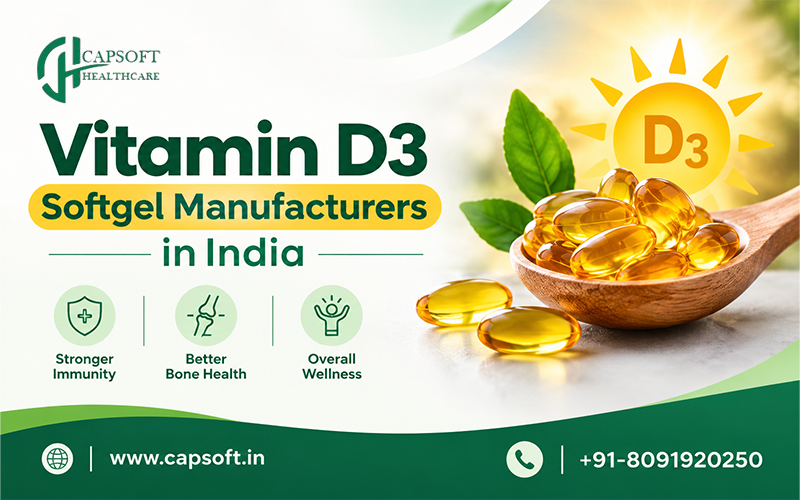
This article covers everything you need to know about vitamin D3 softgels — and why India has become a top global hub for manufacturing them.
Vitamin D3 is one of the hottest nutraceutical ingredients in the world today. Rising deficiency rates and growing awareness around immunity and bone health are driving demand. As a result, more brands are turning to top-quality Vitamin D3 softgel manufacturers in India, which has become a leading global provider of nutraceutical and pharmaceutical softgel manufacturing.
Why Vitamin D3 Softgels Are in High Demand
Vitamin D3 (cholecalciferol) is fat-soluble, so manufacturers deliver it best as a softgel rather than as a powder or tablet. Because Vitamin D3 dissolves in oil rather than water, encasing it in an oil-based softgel significantly boosts its bioavailability compared to other forms.
Several factors are driving the surge in global demand:
- Widespread deficiency across both developing and developed countries
- Greater public awareness of immune-related nutrition following recent global health crises
- A growing preference for preventive care through daily supplementation
- Rising demand for combination formulas — such as D3 with K2, calcium, and omega-3
Because of this mounting demand, many nutraceutical companies now look to India as their next manufacturing hub, since it offers low prices without compromising on quality or regulatory standards.
Why India Is a Preferred Sourcing Destination
India’s pharmaceutical and nutraceutical manufacturing sector has become one of the leading industries globally, and Vitamin D3 softgel production has benefited enormously. Several structural advantages make India a strong sourcing choice:
- A longstanding, integrated pharmaceutical raw material supply chain
- Lower manufacturing costs compared to Western countries
- Skilled staff trained in softgel encapsulation technology
- A robust regulatory framework, with GMP-, ISO-, and WHO-GMP-certified facilities
- Strong export logistics that support distribution to North America, Europe, the Middle East, and Southeast Asia
Thanks to these benefits, many foreign nutraceutical brands now rely on Indian softgel manufacturers — not just for Vitamin D3 formulations, but for oil-soluble formulations of all kinds.
Understanding the Vitamin D3 Softgel Manufacturing Process
Knowing how manufacturers make a D3 softgel can help you understand differences in quality and price before you choose a supplier.
Filling material preparation. Manufacturers dissolve vitamin D3 into a carrier oil, such as soybean, sunflower, or medium-chain triglyceride oil. They then measure out the quantity needed to reach a target dose (for example, 1,000 IU) and mix it uniformly into the oil.
Gelatin shell preparation. Manufacturers make the softgel shell from gelatin, a plasticizer like glycerin, and purified water. Many brands now offer vegetarian or vegan alternatives using modified starch or carrageenan instead of animal-based gelatin.
Rotary die encapsulation. Next, manufacturers mold the gel mass — the oil and D3 mix, plus the shell mixture — and feed it into a rotary die. Two rotating bands form, fill, and seal thousands of capsules per minute while maintaining fill accuracy across the batch.
Quality testing and drying. Finally, manufacturers dry the softgels at carefully controlled moisture and temperature levels. They then test each batch for fill accuracy, disintegration time, and D3 content, since heat, light, and moisture can all degrade the vitamin during drying.
What to Look for When Choosing a Manufacturer
Selecting a manufacturing partner is one of the most important decisions a nutraceutical brand makes, since it directly affects product efficacy, stability, and safety. Before choosing a Vitamin D3 supplier, consider the following:
Certifications and regulatory compliance. Does the manufacturer hold GMP compliance, ISO 9001 accreditation, and — where relevant — WHO GMP or FDA registration? Also confirm they test potency throughout the product’s shelf life, not just at the time of manufacturing.
Raw material sourcing and documentation. Can you review the Certificate of Origin and analytical testing reports for the Vitamin D3 source material? Can the manufacturer demonstrate that the source remains stable throughout the shelf life?
Customization options. Does the supplier offer the flexibility you need, including:
- Dosage strengths from 1,000 IU to 60,000+ IU
- Combinations such as D3 with K2, calcium, or fish oil
- Vegetarian capsules made from plant-based ingredients
- Custom capsule size, color, and branding
Printing capabilities. Look for a manufacturer with in-house printing capacity, since this improves the quality of custom-printed bottles.
Stability and shelf-life testing. Because Vitamin D3 degrades when exposed to environmental elements, ask whether the manufacturer holds stability data confirming the product will retain its potency throughout its advertised shelf life.
Production capacity and lead times. What minimum order quantity (MOQ) does the manufacturer require? What is their monthly production capacity, and what lead times should you expect as your order volume grows?
Export capabilities. If you plan to sell internationally, does the manufacturer have a team familiar with your target country’s export, import, and documentation requirements?
Common Vitamin D3 Softgel Formulations from Indian Manufacturers
Indian softgel makers typically offer:
- Standard Vitamin D3 softgels, ranging from 1,000 IU to 5,000 IU
- Higher-dose softgels for intensive regimens (10,000–60,000 IU per week or month)
- K2/D3 combination softgels for bone and heart health
- Calcium/D3 softgels for bone health
- Fish oil/D3 combination softgels, pairing two popular fat-soluble supplements
- Vegetarian-friendly D3 softgels, which combine plant-based cholecalciferol with a non-gelatin shell
“Our ability to provide so many different formulations means a lot of our nutraceutical customers can consolidate their softgel requirements with just one supplier and manage a broad product range,” says Aakash Chopra, Senior Product Manager at S. D. Fine-Chem.
Capsoft: A Manufacturer to Consider
Capsoft is one manufacturer in India’s softgel space, offering capsules and softgels for nutraceutical and pharma brands, including Vitamin D3 formulations. Before partnering with any manufacturer, however, review their certifications and request samples and documents, such as Certificates of Analysis. Comparing several Vitamin D3 softgel manufacturers in India — based on certifications, formulations, and export experience — will help you find the right partner for your product.
Step-by-Step Guide to Sourcing Vitamin D3 Softgels from India
If you’re a new brand entering the global Vitamin D3 market through Indian manufacturers, follow these steps:
- Finalize your formulation needs. Decide on dosage, ingredients, shell type, and any certifications your target country requires.
- Narrow down manufacturers. Choose a handful of candidates with strong certifications, export expertise, and a broad product range.
- Request samples and documentation. Collect samples, along with Certificates of Analysis, stability studies, and other relevant paperwork.
- Compare prices and MOQs. Review pricing and minimum order policies across your shortlist.
- Place a trial order. Once a few manufacturers meet your requirements, place a small test order.
- Get third-party testing done. This step verifies that the product matches its documentation.
- Finalize your bulk order and shipping.
Common Challenges When Sourcing Vitamin D3 Softgels
Despite India’s strong manufacturing infrastructure, international buyers can still run into a few common issues. Understanding them upfront can help you avoid costly mistakes:
- Potency degradation. Manufacturers must produce and package Vitamin D3 carefully to prevent it from breaking down, which makes stability testing essential.
- Inconsistent quality. Manufacturers without rigorous quality control can produce noticeable variability from batch to batch.
- Incomplete documentation. Smaller manufacturers may lack complete Certificates of Analysis or stability data, which can create regulatory complications in certain markets.
- Communication delays. Time zone and language differences can slow communication if the manufacturer lacks a dedicated export or international sales team.
- Packaging and labeling compliance. Since regulations vary by country, your product’s packaging and labeling must meet the requirements of each target market.
Working with manufacturers that have a dedicated export department and solid documentation practices can help you avoid these pitfalls.
Why Working with Experienced Softgel Manufacturers Matters
Producing high-quality Vitamin D3 softgels requires technically demanding work: precise fill formulation, accurate encapsulation, careful drying temperatures, and reliable potency retention. Many softgel manufacturers lack the equipment or formulation expertise needed to consistently produce an ideal batch. That’s why it’s important to build long-term partnerships with experienced softgel contract manufacturers who understand the challenges of fat-soluble vitamin encapsulation and know how to protect potency throughout production.
Frequently Asked Questions
1. What dosage strengths can Indian manufacturers achieve for Vitamin D3 softgels?
Most manufacturers can produce standard strengths like 1,000 IU and 2,000 IU, as well as high-potency options up to 60,000 IU, depending on your target market’s dosage requirements.
2. Are vegetarian Vitamin D3 softgels available from Indian manufacturers?
Yes. Many Indian manufacturers offer vegetarian softgels made with modified starches instead of gelatin, using an active form of Vitamin D3 sourced from either sheep’s wool or plant sterols.
3. How can I verify the quality of a Vitamin D3 softgel manufacturer in India?
Request Certificates of Analysis, GMP and ISO manufacturing or marketing authorization copies, and shelf-life data. For bulk orders, you should also test physical samples and send them to an independent lab for third-party testing.
4. Can manufacturers combine Vitamin D3 with other ingredients in one softgel?
Yes. Indian manufacturers widely formulate combination supplements that pair Vitamin D3 with K2, calcium, or omega-3s, often for bone health and immunity products.
5. What are typical MOQs for Vitamin D3 softgels?
MOQs vary by manufacturer, formulation type, and packaging. Some offer small trial orders, while others require larger bulk orders. Consult your shortlisted manufacturers directly for specifics.
6. How stable is Vitamin D3 in softgels?
When properly formulated and stored, Vitamin D3 softgels typically maintain their labeled potency for 18–24 months from the manufacturing date. However, stability also depends on the formulation and packaging, so ask your manufacturer for stability data specific to their product.
Final Thoughts
India’s position as a global leader in softgel manufacturing makes it a strong choice for brands seeking reliable Vitamin D3 softgel manufacturers. From formulation expertise and dosage flexibility to competitive pricing and export experience, Indian manufacturers offer the infrastructure needed to bring high-quality Vitamin D3 products to market. As with any sourcing decision, take the time to verify certifications, request samples, and review documentation. For additional guidance on dietary supplement quality and regulatory considerations, refer to the U.S. Food and Drug Administration (FDA) dietary supplement resources. Doing so will help you select a manufacturing partner capable of delivering consistent, potent, and market-ready Vitamin D3 softgels for your brand.