Softgel Capsule Manufacturing Process

Gelatin Capsules Manufacturers in India
August 6, 2026
Vitamin D3 Softgel Manufacturers in India
September 1, 2026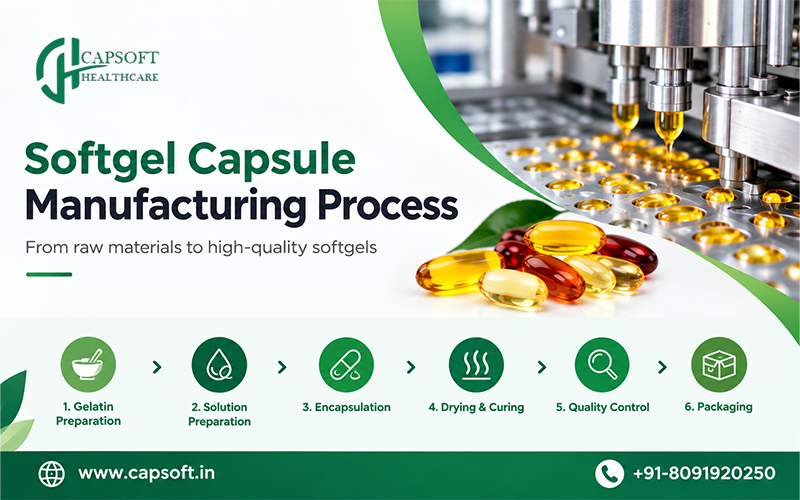
Softgel capsules show up everywhere in pharmacies and nutritionists’ pantries. Vitamin D3, fish oil, herbal extracts, CoQ10 — manufacturers house them all in tiny, sealed capsules designed to release their contents only where intended.
Few people outside the softgel manufacturing industry know how these sealed, seamless capsules come together. This guide walks through the softgel manufacturing process from start to finish and explains what separates a new softgel manufacturer from a veteran one.
What Are Softgel Capsules, and Why Are They Different?
A softgel capsule is a one-piece, hermetically sealed capsule. A gelatin-based shell encloses a liquid, semi-liquid, or oil-based fill. Hard gelatin capsules work differently: manufacturers produce the two-piece empty shells separately, then fill them later. Softgels form and fill in one continuous step, which makes them technically harder to produce than hard capsules.
Manufacturers use softgels widely for:
- Fish oil and omega-3 supplements
- Fat-soluble vitamins such as D, E, and K
- CoQ10 and other oil-soluble nutraceuticals
- Herbal and essential oil extracts
- Some over-the-counter and prescription drugs
Because the shell forms around the fill material, producing softgel capsules requires tight synchronization across gelatin formulation, fill material production, encapsulation, and drying.
Overview of the Softgel Capsule Manufacturing Process
Before looking at each step in detail, here’s the process at a high level:
- Gelatin mass formulation
- Fill material formulation
- Encapsulation (rotary die process)
- Washing and drying
- Inspection and sorting
- Printing and finishing
- Packaging
Each phase demands tight control. Even a slight shift in temperature, humidity, or ingredient ratios can affect a softgel’s integrity, appearance, and shelf life.
How Softgels Are Made
Step 1: Gelatin Mass Preparation
The process starts with the outer shell, known as the gelatin mass. It usually contains three main ingredients:
- Gelatin (from animal tissues, often bovine or fish sources) — provides the gelling properties
- Plasticizer — keeps the shell from becoming too hard and brittle; manufacturers commonly use glycerin or sorbitol
- Purified water — dissolves the gelatin and plasticizer into a homogeneous mass
Manufacturers blend gelatin, plasticizer, and water in large heated vessels, at 60°C to 70°C, until the mixture becomes smooth and lump-free. They then degas the mass under vacuum to remove air bubbles, since trapped air can weaken capsules or cause visible defects. At this stage, they typically add colorants or opacifiers if the shell needs a specific color or an opaque finish. The finished gelatin mass sits in temperature-controlled storage vessels until encapsulation begins.
Step 2: Fill Material Preparation
The fill material needs to flow freely — an oil, suspension, or paste-based liquid works with standard encapsulation equipment. Fill materials can include:
- Active ingredients (natural oils, botanicals, vitamin extracts, APIs)
- Carrier oils (soybean oil, medium chain triglycerides/MCT oil)
- Emulsifiers, stabilizing agents, and suspending agents as needed
Once the formulation team blends the fill, they degas it under vacuum to remove trapped air, since air bubbles can affect capsule integrity, appearance, and dosing accuracy. They filter the material when necessary to prevent blockages in the dispensing pumps, and they measure and verify its viscosity for compatibility with the rotary die fill mechanism.
Getting the fill’s viscosity right is one of the most critical parts of development. Fill that’s too viscous can overwhelm the pump. Fill that’s too thin can leak and reduce capsule integrity over time.
Step 3: Encapsulation Using the Rotary Die Process
This technique drives commercial softgel production. It manufactures, fills, and seals softgel capsules in one continuous operation. Here’s how it works:
- Rotating drums form the molten gelatin mass into two continuous ribbons, which spreader boxes direct over the rotating die rollers.
- The two rotating dies, precisely synchronized, receive the gelatin ribbons.
- As the ribbons pass between the dies, a rotary die fill mechanism — typically a wedge-shaped injection block — injects fill material precisely between them.
- The dies press the ribbons together, using heat and pressure to cut and seal each capsule into a seamless shell almost simultaneously.
- The new softgels exit the dies and drop into a refrigerated collection trough or conveyor for the next step.
A well-designed rotary die machine can produce tens of thousands of accurately dosed, uniformly shaped capsules per hour.
Step 4: Washing and Drying
Freshly made softgels come out wet and slightly sticky. Because gelatin is a water-soluble protein, manufacturers wash away any residual surface oil or gel formulation, then dry the capsules under controlled conditions to reach the right moisture content. Softgels typically go through one or more wash cycles, using purified water or a food-grade alcohol solvent depending on the formulation and washing method.
From there, the capsules move to drying drums and dry in controlled-atmosphere conditions for several hours — often 24 to 48 hours total.
Drying is one of the most critical steps in the whole process. Dry too slowly, and microbial growth becomes a risk. Dry too quickly, and the capsules can become hard, brittle, and prone to cracking. Controlled temperature and humidity drying rooms let manufacturers manage the drying rate and final moisture content precisely.
Step 5: Inspection and Sorting
Every batch goes through rigorous quality checks. Automated and manual inspection processes confirm:
- No defects such as leaks, tears, or poor seals
- No air bubbles trapped in the shell
- Consistent shape and size
- No discoloration, spots, or surface tackiness
- Correct fill volume or weight
Large-scale production relies on high-speed optical sorting machines, which can check capsules for defects at very high rates. Smaller or specialized runs often depend more heavily on visual inspection by qualified technicians.
Step 6: Printing and Finishing
Many manufacturers print softgel capsules for brand recognition, patient identification, logos, lot numbers, or warnings. They typically use an ink pad printer (offset method) or offset printing machines built for capsule printing, with pharmaceutical-grade inks.
Some capsules need to reach the intestine before releasing their contents — to protect acidic stomach contents or sensitive APIs from the stomach’s harsh conditions, or to control the release rate. For these, manufacturers apply an additional enteric coating in a coating pan or fluid bed coater. Enteric-coated capsules often need a further drying step or stabilization period.
Step 7: Packaging
Once a batch passes inspection, manufacturers package the finished softgels according to customer or product requirements. Packaging options range from bulk drums or containers for contract manufacturing partners to retail formats like bottles with desiccants or blister packs that protect each capsule individually. Whatever the format, packaging must protect the softgels from moisture and light, since both can degrade the product over its shelf life.
Quality Control Throughout the Softgel Manufacturing Process
Quality control doesn’t happen at just one stage — it runs through every stage. Trustworthy softgel manufacturers build quality checks into nearly every step, including:
- Testing raw materials before production begins
- Monitoring gelatin viscosity, fill accuracy, and encapsulation rate in process
- Tracking temperature and humidity in drying rooms
- Testing batches for disintegration rate, dissolution rate, and bacterial counts
- Running stability tests to determine shelf life under different storage conditions
This layered approach to quality assurance is one of the clearest signs that separates trusted manufacturers from less reliable ones.
Why Choosing the Right Softgel Manufacturer Matters
The technical, multi-step nature of softgel production means your choice of manufacturing partner can dramatically affect quality, consistency, and regulatory compliance. If you’re launching a nutraceutical or pharmaceutical softgel product, look for a manufacturer who:
- Holds GMP, ISO, or WHO-GMP certification
- Uses purpose-built rotary die encapsulation machinery, not a rented or improvised setup
- Offers formulation and R&D support so you can develop a customized fill formula
- Maintains lab capabilities for thorough batch testing
- Can service both domestic and export orders
Capsoft is one company that provides softgel and capsule manufacturing services to nutraceutical and pharmaceutical businesses. As with any manufacturing partnership, you should do your own due diligence — verify certifications, review sample products, and assess facility performance before placing an order.
Common Challenges in Softgel Manufacturing
Even experienced manufacturers run into recurring technical issues during production. Knowing these challenges helps you ask better questions when evaluating a contract manufacturer:
- Fill/shell incompatibilities — Certain active ingredients interact with gelatin and degrade over time, which calls for the right formulation solutions.
- Migration — Lower-viscosity fills can migrate through the softgel shell, affecting appearance and integrity.
- Crosslinking — Over time, the gelatin shell can undergo “crosslinking,” which increases disintegration time. Manufacturers monitor this closely during stability studies.
- Scale-up — A formulation that performs well in development trials doesn’t always translate to full-scale production without adjustments.
Frequently Asked Questions
1. What’s the fundamental difference between softgel manufacturing and hard capsule filling? Softgel encapsulation creates, fills, and seals the capsule in one operation using a rotary die. Hard capsule production works in two separate steps: manufacturers make the empty shells first, then fill them with the drug formulation afterward. That makes softgel encapsulation more integrated and more complex overall.
2. How long does the softgel manufacturing process take? The full process — from gelatin mass preparation to final packaging — can take anywhere from a few days to over a week, largely because of the extended drying stage. Capsules need enough drying time to reach the right moisture content and hardness for filling, shelf life, and processing.
3. What ingredients go into softgel capsules? Softgel capsules consist of a shell and a filling. The shell is primarily gelatin, a plasticizer (such as glycerin or sorbitol), and water. The filling can include virtually any substance suited to encapsulation.
4. Can manufacturers produce vegetarian, vegan, kosher, or halal softgels? Yes. Many softgel manufacturers offer vegan-friendly, plant-based shells and other alternatives for religious dietary requirements, using carrageenan or modified starch instead of animal-derived gelatin.
5. Why does drying matter so much for softgels? Drying determines both a capsule’s shape/hardness and its moisture content. Incomplete drying can cause capsules to stick together or clump, leading to waste. Over-drying can make capsules brittle and prone to breaking during handling or storage.
6. How do I find a softgel manufacturer with the right quality control standards? Confirm the manufacturer complies with GMP regulations, ISO guidelines, and WHO-GMP standards where applicable. Ask for batch analysis reports, review audit documentation, and consider a facility visit or audit before committing to a large order.
Final Thoughts
Softgel capsule manufacturing is a precise, multi-stage process that combines chemistry, mechanical engineering, and rigorous quality management. The result looks deceptively simple but takes real complexity to produce. From preparing the gelatin mass, through rotary die formation and fill injection, to drying and final packaging — every stage matters for the safety, stability, and effectiveness of the finished capsule. If you want your nutraceutical or pharmaceutical product to succeed in the market, partnering with a competent softgel manufacturer is one of the most important decisions you’ll make.