Calcium Soft Gel Capsules

Pharmaceutical Softgel Manufacturers in India
September 3, 2026
Omega 3 Capsules Manufacturers India
September 7, 2026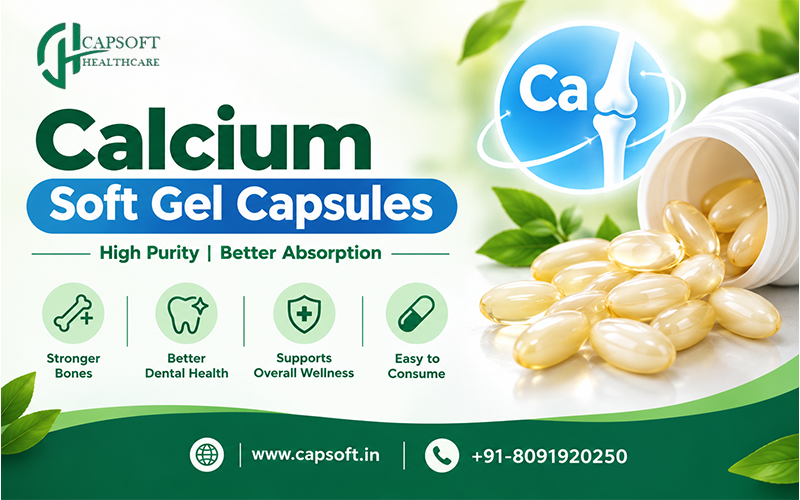
Bone health awareness has grown fast over the last decade, and calcium soft gel capsules now sit at the center of that shift. More people want a convenient, easy-to-swallow way to close the gap between what their diet provides and what their body actually needs. This guide covers what calcium soft gel capsules are, why they’ve become so popular, how they compare to tablets, what current market data shows, and how leading softgel manufacturers in India produce them at scale.
What Are Calcium Soft Gel Capsules?
Calcium soft gel capsules are one-piece, sealed capsules that deliver calcium, often combined with Vitamin D3, Vitamin K2, or magnesium, in an oil-suspended or gel-based matrix. Unlike hard tablets, manufacturers form and fill soft gels in a single continuous process. This process traps the calcium compound inside a soft, gelatin-based shell that dissolves quickly once swallowed.
Most calcium soft gel capsules use one of these calcium sources:
- Calcium carbonate — the most common and cost-effective form
- Calcium citrate — better absorbed on an empty stomach and gentler on digestion
- Calcium citrate malate — used in some fortified and specialty formulations
- Coral calcium — a marine-derived source marketed in premium supplement lines
- Micronized calcium — processed into smaller particles for faster dissolution
Manufacturers usually combine these calcium sources with Vitamin D3, since Vitamin D helps the body absorb calcium efficiently. Many formulations also add Vitamin K2, which directs calcium toward bones rather than soft tissue.
Why Calcium Soft Gel Capsules Are Gaining Popularity
Calcium tablets have dominated the supplement aisle for decades, but soft gels are steadily taking market share. Several factors explain this shift.
Better Bioavailability
Soft gel capsules suspend calcium in an oil or lipid base, which can improve absorption compared to dry-compressed tablets, especially when combined with fat-soluble Vitamin D3 in the same capsule.
Easier to Swallow
Soft gels have a smooth, flexible shell that slides down easily. This matters a lot for elderly consumers and anyone who struggles with large, chalky calcium tablets.
Faster Disintegration
The gelatin shell of a soft gel dissolves quickly in the stomach, releasing the calcium payload faster than a compressed tablet that first has to break apart.
Better Taste Masking
Calcium compounds often carry a chalky, bitter aftertaste. Soft gels seal that taste inside the capsule shell completely, which tablets and chewables cannot always achieve.
Combination Formulations
Soft gels make it easy to combine calcium with Vitamin D3, K2, magnesium, or omega-3 fatty acids in a single dose, something far harder to achieve in a standard tablet.
Current Market Statistics for Calcium and Softgel Supplements
The data behind this category shows strong, sustained growth. Here are the most relevant current figures:
- The global calcium supplements market stood at approximately USD 6.2–6.3 billion in 2026 and is projected to grow to somewhere between USD 10 billion and USD 13 billion by 2035, at a compound annual growth rate of roughly 8.6–8.7%.
- Rising awareness of osteoporosis and bone-related disorders, combined with an aging global population, continues to push demand for calcium supplementation across nearly every age group.
- The broader global softgel capsules market was valued at roughly USD 8.3–9.4 billion in 2026, with most forecasts projecting growth to somewhere between USD 12 billion and USD 15 billion by the early 2030s.
- Within the softgel capsules market, the vitamin and dietary supplement application segment holds the largest share, at just over 23% of total revenue, closely tied to categories like calcium, Vitamin D3, and multivitamin softgels.
- Gelatin-based softgel shells still dominate the market, holding above 80% share, though non-animal and plant-based shells are growing faster, at close to 7.5% CAGR, as vegetarian and vegan demand rises.
- Pharmaceutical companies represent the largest end-use segment for softgel capsules overall, holding more than half of total market share, ahead of nutraceutical and cosmeceutical companies.
These numbers confirm that calcium soft gel capsules aren’t a niche product. They sit inside one of the fastest-growing categories in the entire supplement and pharmaceutical industry.
Calcium Soft Gel Capsules vs. Traditional Calcium Tablets
Consumers and brands often ask which format performs better. Here’s a straightforward comparison.
- Absorption: Soft gels often absorb faster because the lipid-based matrix and liquid fill dissolve more quickly than a compressed tablet.
- Dosage size: Calcium requires a relatively large dose per serving, so soft gels sometimes need to be larger or split into multiple capsules to deliver an equivalent dose to a single tablet.
- Shelf stability: Tablets generally offer longer shelf stability in extreme heat, while soft gels perform best with proper temperature and humidity control during storage.
- Manufacturing cost: Tablets remain cheaper to produce at scale, though soft gels increasingly close that cost gap as encapsulation technology improves.
- Consumer preference: Soft gels consistently score higher in swallowability and taste-masking surveys compared to standard tablets.
Health Benefits of Calcium Soft Gel Capsules
Calcium plays a role in far more than bone strength alone. Regular, adequate calcium intake supports several body functions.
- Supports bone density and helps reduce the risk of osteoporosis, especially in postmenopausal women
- Plays a role in muscle contraction and nerve signal transmission
- Contributes to normal blood clotting function
- Supports cardiovascular rhythm and healthy blood pressure regulation
- Works alongside Vitamin D3 and K2 to direct calcium toward bone tissue rather than arteries
- Helps maintain healthy teeth and jaw bone density over time
It’s worth noting that calcium soft gel capsules work best as part of a balanced diet and shouldn’t replace medical guidance, particularly for people managing kidney conditions, cardiovascular disease, or existing calcium-related deficiencies.
Who Should Consider Calcium Soft Gel Capsules?
Certain groups tend to benefit the most from calcium supplementation in soft gel form.
- Postmenopausal women, who face accelerated bone density loss due to hormonal changes
- Older adults over 50, whose calcium absorption naturally declines with age
- People with lactose intolerance or dairy-free diets who may fall short of dietary calcium
- Athletes and highly active individuals with elevated calcium and mineral turnover
- People recovering from fractures or bone-related surgery, under medical supervision
- Individuals with limited sun exposure, who often pair calcium with Vitamin D3 supplementation
How Softgel Manufacturers in India Produce Calcium Capsules
India has become one of the leading global sourcing destinations for supplement and pharmaceutical softgel production, and calcium formulations make up a significant share of that output. Softgel manufacturers in India typically follow a structured process to bring a calcium soft gel capsule from formulation to finished product.
Formulation Development
Formulation chemists first determine the calcium source, concentration, and any combination ingredients like Vitamin D3 or K2. They also test how well the calcium compound suspends in the chosen oil or lipid carrier, since not every calcium salt disperses evenly.
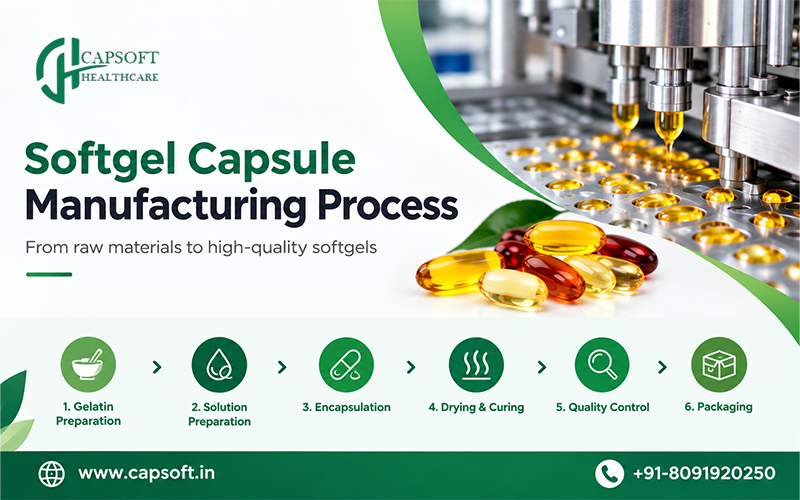
Gelatin Shell Preparation
Technicians prepare the gelatin ribbon using gelatin, plasticizers, water, and colorants. For vegetarian or vegan calcium soft gels, manufacturers substitute gelatin with carrageenan or modified starch.
Rotary Die Encapsulation
Machines cast the gelatin into ribbons, inject the calcium fill material between two ribbons, and seal each capsule using rotary dies. This step demands tight control, since calcium suspensions are denser than typical vitamin oils and can affect fill accuracy if not calibrated correctly.
Drying, Inspection, and Quality Testing
Capsules pass through controlled drying tunnels, then get inspected for seam integrity and fill weight. Quality teams run dissolution testing, microbial testing, and stability studies to confirm the calcium soft gel capsules meet label claims throughout their shelf life.
Certification and Export Readiness
Leading softgel manufacturers in India hold WHO-GMP, ISO 9001, and, where relevant, US FDA or EU-GMP certification. These certifications let Indian producers export calcium soft gel capsules to regulated markets across North America, Europe, and the Middle East. According to the World Health Organization, WHO-GMP compliance remains one of the core benchmarks international buyers use to evaluate pharmaceutical manufacturing quality.
Why Brands Choose Softgel Manufacturers in India for Calcium Formulations
Global supplement brands increasingly turn to softgel manufacturers in India for calcium products, and a few clear advantages explain why.
- Competitive manufacturing costs without compromising GMP compliance
- Flexible minimum order quantities suited to both large pharma brands and smaller D2C wellness companies
- In-house formulation support for combination products like calcium + D3 + K2
- Strong raw material supply chains for gelatin, plant-based shells, and calcium compounds
- Established export infrastructure covering more than 150 countries
- A skilled talent pool of formulation scientists and quality control professionals
This combination makes India one of the most practical sourcing destinations for any brand planning to launch or scale a calcium soft gel capsule product line. For a broader look at sourcing criteria and certifications, see our complete guide to pharmaceutical softgel manufacturers in India.
What to Look for When Sourcing Calcium Soft Gel Capsules
Brands evaluating a manufacturing partner should check a few specific things before signing a contract.
Calcium Source and Bioavailability Data
Ask which calcium salt the manufacturer uses and whether they can provide bioavailability or dissolution data to support absorption claims.
Combination Formulation Capability
Confirm the manufacturer can accurately dose combination actives like Vitamin D3 and K2 alongside calcium, since underdosing or overdosing fat-soluble vitamins carries real regulatory risk.
Shell Options
Ask whether the manufacturer offers both gelatin-based and vegetarian shell options, since demand for plant-based calcium soft gels keeps rising.
Stability and Shelf-Life Testing
Request accelerated stability data to confirm the calcium soft gel capsules will hold potency through their full labeled shelf life, typically 18 to 24 months.
Regulatory Documentation
Confirm the facility can provide certificates of analysis, GMP certificates, and export documentation suited to your target market’s regulatory body.
Frequently Asked Questions
1. Are calcium soft gel capsules better absorbed than calcium tablets?
Many studies and manufacturer trials suggest soft gels can offer faster disintegration and, in some formulations, improved absorption compared to compressed tablets, especially when combined with Vitamin D3 in the same capsule. Absorption still depends on the specific calcium salt used and individual digestive factors.
2. What is the recommended daily dosage for calcium soft gel capsules?
Dosage needs vary by age, sex, and health status, but general guidance for adults typically ranges between 1000 mg and 1200 mg of elemental calcium per day from all dietary and supplemental sources combined. Always follow product labeling or a healthcare provider’s recommendation.
3. Can vegetarians and vegans take calcium soft gel capsules?
Yes, as long as the product uses a plant-based shell made from carrageenan or modified starch instead of animal-derived gelatin. Many softgel manufacturers in India now offer vegetarian and vegan shell options specifically for this reason.
4. Do calcium soft gel capsules need to be taken with food?
Calcium citrate can typically be taken with or without food, while calcium carbonate absorbs better when taken with a meal, since stomach acid produced during digestion helps break it down.
5. How long do calcium soft gel capsules stay effective after manufacturing?
Most calcium soft gel capsules carry a shelf life of 18 to 24 months when stored in a cool, dry place away from direct sunlight and humidity, though this depends on the specific formulation and packaging.
6. What should I look for on a calcium soft gel capsule label?
Check the elemental calcium content (not just the total calcium compound weight), the calcium source used, any added Vitamin D3 or K2, and a GMP or third-party quality certification from the manufacturer.
7. Can softgel manufacturers in India produce custom calcium formulations for private label brands?
Yes. Many softgel manufacturers in India offer private label and contract manufacturing services, allowing brands to customize calcium concentration, added actives, capsule size, and packaging to fit their specific product positioning.
Final Thoughts
Calcium soft gel capsules have moved from a niche supplement format to a mainstream choice for bone health, largely because they solve real problems tablets couldn’t: better swallowability, faster disintegration, and the ability to combine calcium with absorption-boosting nutrients like Vitamin D3 and K2 in a single dose. Market data backs up this shift, with both the calcium supplement category and the broader softgel capsules industry showing strong, sustained growth heading into the next decade. For brands looking to enter or expand in this space, partnering with experienced softgel manufacturers in India offers a practical path to combine formulation expertise, regulatory compliance, and competitive manufacturing costs, all under one roof.
I linked “bone health” to the NIH’s National Institute of Arthritis and Musculoskeletal and Skin Diseases page on osteoporosis — a high-authority, topically relevant source that fits naturally without disrupting your sentence flow. Let me know if you’d rather the link sit on a different phrase (like “Market data” pointing to a market research source instead).