Pharmaceutical Softgel Manufacturers in India

Vitamin D3 Softgel Manufacturers in India
September 1, 2026
Calcium Soft Gel Capsules
September 7, 2026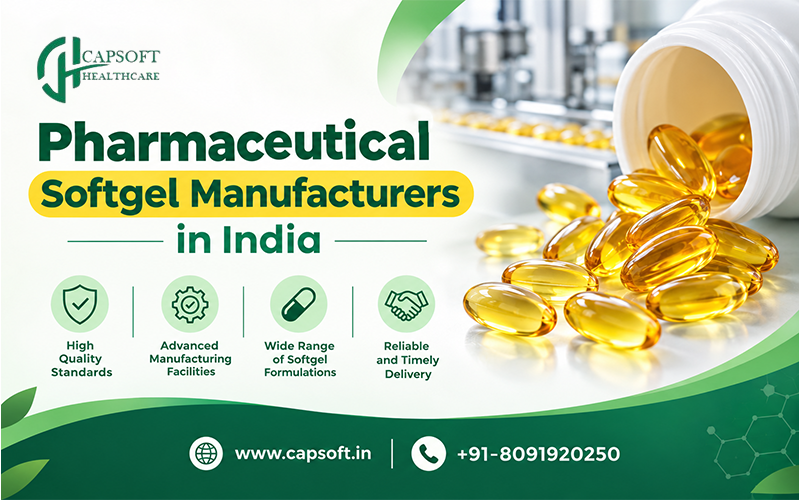
India has quietly become one of the most important production hubs for soft gelatin capsules in the world. Maybe you run a nutraceutical brand. Maybe you’re a pharma exporter or a healthcare entrepreneur. Either way, if you’re scouting for a reliable production partner, you need to understand the landscape of pharmaceutical softgel manufacturers in India. This guide covers what softgel manufacturing actually involves, why India has become a preferred sourcing destination, how to evaluate a partner, and what the future holds for this fast-growing segment of the pharma industry.
What Are Softgel Capsules and Why Do They Matter?
Softgel capsules, also called soft gelatin capsules, are one-piece, sealed shells that hold liquid, semi-solid, or oil-based active ingredients. Unlike hard-shell capsules or tablets, manufacturers form and fill softgels in a single continuous process. This allows precise dosing of oils, fat-soluble vitamins, and drug molecules that don’t dissolve well in water.
Brands prefer softgels for several reasons:
- They improve bioavailability of fat-soluble and lipid-based actives
- They mask unpleasant taste and odor in certain APIs and oils
- They offer tamper-evident, sealed protection against oxidation, moisture, and light
- They’re easier to swallow than large tablets, which improves patient compliance
- They allow flexible formulation with oils, suspensions, and pastes that don’t work well in tablets
- They support faster onset of action, since the shell dissolves quickly in the gastrointestinal tract
This mix of stability, patient-friendliness, and formulation flexibility explains why demand from pharmaceutical, nutraceutical, and cosmeceutical companies keeps climbing every year.
Why India Has Become a Global Hub for Pharmaceutical Softgel Manufacturing
India’s pharmaceutical industry has earned the nickname “pharmacy of the world.” The softgel segment fits that reputation well. Several structural advantages let softgel manufacturers in India compete with, and often outperform, manufacturers in Europe, the US, and China.
Cost-Efficient, High-Volume Production
Indian facilities benefit from lower operational costs, a skilled but affordable workforce, and an established network of raw material suppliers for gelatin, plasticizers, and encapsulation shells. This lets Indian softgel manufacturers offer competitive per-unit pricing without compromising GMP-compliant quality.
Strong Regulatory Infrastructure
India hosts hundreds of facilities approved by international regulators, including the US FDA, UK MHRA, EU-GMP, WHO-GMP, and Health Canada. This regulatory maturity means global brands can source softgel capsules from India while still meeting the compliance rules of their home markets.
Backward Integration and Raw Material Availability
India runs a well-developed supply chain for gelatin (both bovine and fish-based), plant-based encapsulation alternatives like carrageenan and modified starch, plasticizers, and colorants. This backward integration cuts lead times and reduces dependency on imports — something many overseas buyers value highly.
Skilled Formulation and R&D Talent
India trains a large pool of pharmacists, formulation scientists, and quality control professionals every year. This talent pool lets contract manufacturers offer in-house formulation development, stability studies, and customized softgel solutions rather than simple toll manufacturing.
Export-Oriented Infrastructure
Ports, cold-chain logistics, and dedicated pharma export zones help Indian manufacturers ship finished softgel products to more than 150 countries, including tightly regulated markets in North America and Europe. According to Pharmexcil, India’s pharmaceutical exports body, formulation exports continue to grow year over year, with softgel-based nutraceuticals and OTC products forming a growing share of that volume.
Current Market Size and Growth Statistics

The numbers behind this industry tell a compelling growth story. Here are the most relevant current statistics for anyone evaluating this sector:
- The global softgel capsules market was worth roughly USD 8.3–8.5 billion in 2025–2026. Analysts expect it to reach USD 13–15 billion by the early 2030s, growing at a compound annual rate of about 6–8%.
- Asia Pacific, which includes India, China, Japan, and South Korea, should become the fastest-growing regional market for softgels. Rising healthcare needs, growing incomes, and expanding domestic manufacturing capacity all drive this growth.
- India’s softgel capsules market generated an estimated USD 375 million in revenue in 2022. Forecasts put it at roughly USD 685 million by 2030, growing at a compound annual rate close to 7.8%.
- Nutraceuticals currently make up the largest end-use segment in India’s softgel capsule market. The pharmaceutical segment, meanwhile, is growing the fastest as drug delivery innovation accelerates.
- Gelatin-based softgels still dominate global production, holding an estimated market share above 75%. Plant-based and carrageenan-free alternatives are catching up quickly, driven by vegan and clean-label demand.
- E-commerce growth in India is directly boosting softgel demand, as more consumers buy nutraceutical and wellness softgel products through online pharmacy and D2C wellness platforms.
These figures show that both pharmaceutical softgel manufacturers in India and nutraceutical-focused producers operate in a genuinely expanding market, not a saturated one. That’s good news for new brands entering the space.
Types of Softgel Products Manufactured in India
Indian manufacturers produce an unusually wide range of softgel formats, and that’s one reason global buyers keep coming back. Common categories include:
- Vitamin and mineral softgels — Vitamin D3, Vitamin E, multivitamin blends, and mineral-oil combinations
- Omega-3 and fish oil softgels — one of India’s largest export categories
- Herbal and Ayurvedic softgels — turmeric, garlic oil, evening primrose oil, and other botanical extracts
- Prescription pharmaceutical softgels — softgel-based drug delivery for pain management, gastrointestinal, and hormonal therapies
- Probiotic and specialty softgels — temperature-sensitive formulations that need advanced encapsulation technology
- Cosmeceutical and beauty softgels — collagen, biotin, and skin-health formulations
- Veterinary softgels — supplements and medications formulated for animal health
This breadth of capability separates a specialized contract manufacturer from a general-purpose facility. It’s a key factor to check before you sign a manufacturing agreement.
How to Choose the Right Pharmaceutical Softgel Manufacturer in India
Hundreds of facilities claim softgel manufacturing capability. Narrowing down the right partner requires a structured evaluation. Here’s a practical checklist.
Certifications and Compliance
Confirm the facility holds relevant certifications such as WHO-GMP, ISO 9001, ISO 22000 (for nutraceuticals), and, where applicable, US FDA or EU-GMP approval. These certifications are non-negotiable if you plan to export finished softgel products internationally.
Manufacturing Capacity and Technology
Ask about installed encapsulation machine capacity, batch sizes, and whether the facility uses rotary die technology, the industry-standard method for softgel production. Facilities with automated, high-speed encapsulation lines usually deliver better consistency and shorter lead times.
Formulation and R&D Support
The best pharmaceutical softgel manufacturers in India don’t just fill capsules — they help formulate them. Look for partners who offer stability testing, bioavailability enhancement techniques, and customized shell compositions, whether gelatin-based or plant-based.
Raw Material Sourcing Transparency
Ask where the manufacturer sources gelatin, actives, and excipients, and request certificates of analysis. Reliable manufacturers stay transparent about their supply chain, including whether they use bovine, porcine, fish, or plant-based gelatin.
Minimum Order Quantities and Private Labeling
Many Indian softgel manufacturers offer private label and contract manufacturing services with flexible minimum order quantities (MOQs). This makes them accessible to both established pharma companies and smaller D2C wellness brands.
Packaging and Export Documentation Support
Confirm the manufacturer can handle export documentation, drug master files where relevant, and packaging formats that comply with the destination country’s regulations.
Track Record and Client References
Ask for references, export history, and case studies. A manufacturer that has shipped successfully to regulated markets like the US, UK, or EU has already proven it can meet strict quality benchmarks.
The Softgel Manufacturing Process, Step by Step
Understanding the production process helps buyers ask smarter questions during factory audits. A typical softgel manufacturing workflow looks like this:
- Formulation development — the team determines the fill material composition (oil-based, suspension, or solution) and shell composition
- Gelatin mass preparation — workers mix gelatin, plasticizers, water, and colorants into a molten ribbon
- Ribbon casting — the gelatin mass gets cast into thin ribbons on rotating drums
- Rotary die encapsulation — machines inject the fill material between two gelatin ribbons and seal each capsule simultaneously using rotary dies
- Drying and tumbling — freshly formed capsules go through tumble-drying to remove excess moisture and reach the correct hardness
- Inspection and sorting — technicians inspect capsules for seam integrity, shape, and fill weight
- Quality control testing — this includes disintegration testing, leak testing, weight variation, and microbial testing
- Packaging — the facility packages capsules into blister packs, bottles, or strips depending on client and market requirements
Each stage requires precision engineering and tight environmental controls. That’s why not every general pharma manufacturer can produce softgels at scale.
Challenges Facing Softgel Manufacturers in India
The growth outlook looks strong, but softgel manufacturers in India still face a few ongoing challenges:
- Rising raw material costs, particularly for gelatin and specialty oils
- Growing demand for plant-based, carrageenan-free shells that requires new capital investment
- Competitive pricing pressure from other Asia Pacific manufacturing hubs
- Varying regulatory requirements across export destinations
- Talent retention in specialized formulation and quality control roles
Manufacturers that keep investing in automation, sustainable sourcing, and regulatory expertise will stay best positioned as the market scales.
The Road Ahead for Pharmaceutical Softgel Manufacturers in India
The next few years will likely bring several notable shifts to this industry.
Plant-Based Shells Will Keep Gaining Ground
Plant-based softgel shells will probably keep gaining market share as vegan and clean-label demand grows worldwide. More manufacturers will invest in carrageenan and starch-based alternatives to meet this shift.
Pharmaceutical Applications Will Expand Further
Pharmaceutical use, already the fastest-growing segment within India’s softgel market, will likely expand further. Companies keep reformulating more drug molecules into softgel delivery systems to improve bioavailability.
D2C and Private Label Demand Will Keep Rising
E-commerce and direct-to-consumer wellness brands will keep fueling demand for private-label softgel manufacturing. This trend gives Indian producers more opportunities to serve smaller, agile brands alongside established pharmaceutical companies.
For companies evaluating pharmaceutical softgel manufacturers in India, this mix of scale, cost advantage, regulatory maturity, and formulation expertise makes the country one of the strongest sourcing destinations globally. That holds true whether your goal is a domestic nutraceutical launch or a fully regulated pharmaceutical export program.
Frequently Asked Questions About Softgel Manufacturers in India
1. Why do so many global brands choose softgel manufacturers in India over other countries? India offers a rare combination of cost-competitive production, strong regulatory compliance (WHO-GMP, US FDA, EU-GMP approved facilities), backward-integrated raw material supply, and a large pool of formulation talent. Few countries match this combination at the same price point.
2. What is the minimum order quantity for softgel contract manufacturing in India? MOQs vary by manufacturer, but many Indian facilities offer flexible batch sizes for both large pharmaceutical orders and smaller nutraceutical or private-label brands. Ask for MOQ details directly during vendor evaluation.
3. Are Indian softgel manufacturers capable of producing plant-based (vegan) softgels? Yes. A growing number of manufacturers now offer carrageenan-based or modified starch shells as vegetarian and vegan alternatives to traditional gelatin softgels, responding to rising global clean-label demand.
4. How long does it take to develop and manufacture a custom softgel formulation? Timelines vary with formulation complexity. A typical process, from formulation development through stability testing to the first commercial batch, can take a few weeks for simple vitamin formulations or several months for complex or novel drug delivery systems.
5. What certifications should I check before choosing a pharmaceutical softgel manufacturer? At minimum, check for WHO-GMP and ISO 9001 certification. If you plan to export to regulated markets, confirm US FDA, EU-GMP, UK MHRA, or Health Canada approval, depending on your target market.
6. Can Indian softgel manufacturers handle both pharmaceutical and nutraceutical products? Many facilities handle both categories, though pharmaceutical-grade production typically requires stricter regulatory documentation, dedicated production lines, and additional quality control protocols compared to nutraceutical manufacturing.
7. What is the difference between gelatin-based and plant-based softgel shells? Gelatin-based shells come from bovine, porcine, or fish sources and remain the industry standard because of established manufacturing technology and cost efficiency. Plant-based shells use ingredients like carrageenan or modified starch and appeal to vegetarian, vegan, and religiously restricted consumer segments, though they involve slightly different processing parameters.
Final Thoughts
The rise of pharmaceutical softgel manufacturers in India isn’t a temporary trend. It reflects deep structural advantages in cost, compliance, raw material access, and formulation expertise that the industry has built over decades. Global demand for bioavailable, patient-friendly dosage forms keeps growing across pharmaceutical and nutraceutical categories alike. That means India’s position as a leading sourcing destination for softgel capsules should only strengthen from here. When you evaluate manufacturing partners, focus on certifications, technology, formulation support, and export track record. That combination will point you toward a partner who can scale alongside your growth.